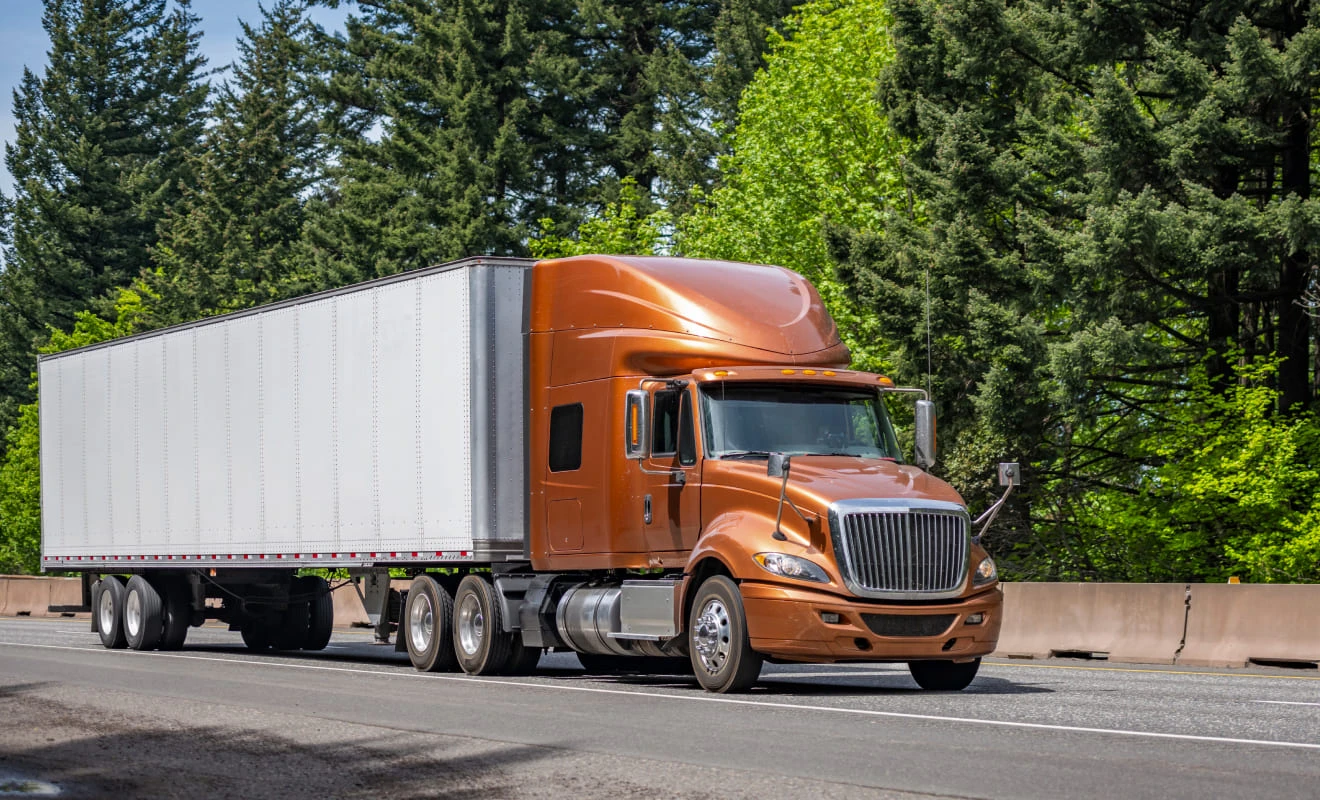

Trucks moved $64.2 billion in freight across the U.S.-Mexico border in April 2026. That single figure, from the Bureau of Transportation Statistics, should change how you think about your southbound and northbound lanes. Mexico truck freight is no longer a niche appendix to a domestic transportation plan. It is a market bigger than most shippers’ entire domestic regions, concentrated at a handful of gateways, and it fails differently than domestic FTL when something goes wrong.
Here is what the latest official data says, and how to build a Mexico lane plan that treats cross-border freight as its own discipline instead of ordinary truckload with extra paperwork.
The Scale of the April Numbers
BTS reported that U.S. freight with Canada and Mexico totaled $150.8 billion in April, up 19.4 percent from April 2025. One caveat belongs up front, and it matters for planning. BTS reports these values in current dollars, so that 19.4 percent is not an inflation-adjusted volume measure. Treat it as a signal of scale and direction, not proof that physical shipment counts grew by a fifth.
Within that total, the two borders are not equal. U.S.-Canada freight reached $64.8 billion, up 14.4 percent year over year. U.S.-Mexico freight hit $86.0 billion, up 23.4 percent, making Mexico both the larger and the faster-growing trade lane.
Trucking dominates how that freight actually moves. Trucks carried $98.4 billion of North American transborder freight in April, an 18.8 percent year-over-year increase and more value than any other transportation mode. Split by border, truck freight accounted for $34.1 billion at the Canadian border and $64.2 billion at the Mexican border. If your company trades with Mexico, the odds are overwhelming that your goods are on a truck for the border crossing itself.
A Market Concentrated at a Handful of Gateways
The transborder network is not evenly spread. BTS lists the top truck gateways as Detroit, Port Huron, and Buffalo on the Canadian border, and Laredo, El Paso, and Otay Mesa on the Mexican border. Laredo alone handled $33.416 billion across all modes in April.
That concentration is efficient right up until it is not. When a third or more of a border’s value funnels through one gateway, a bridge closure, a systems outage at a customs facility, a weather event, or a simple surge in crossings ripples through thousands of supply chains at once. A shipper whose entire Mexico program assumes Laredo will always flow is carrying single-point-of-failure risk that would never be tolerated in a domestic network design.
Why Mexico Lanes Deserve Their Own Playbook
Treating Mexico FTL shipping as domestic truckload with a longer transit is the root cause of most cross-border service failures. A domestic load has one carrier, one driver, and one handoff at destination. A typical cross-border move can involve a U.S. linehaul carrier, a border drayage operation, a Mexican carrier, a customs broker on each side, and a warehouse or transload facility in between. Every handoff is a point where a document mismatch or a missed appointment stops freight that was otherwise moving perfectly.
Align documents and appointments across every partner
Build your Mexico process around synchronization, not just transit time.
- One data set, every party. Commercial invoice, packing list, and customs entry data should match exactly across the shipper, broker, and carrier before the truck leaves origin, because discrepancies surface at the border, where fixing them is slowest.
- Appointments booked as a chain. Pickup, border crossing, transload, and delivery windows need to be planned as one connected schedule with explicit buffer, not as four independent bookings.
- A named owner for the handoff. When freight sits at the border, the costliest minutes are the ones spent figuring out whose problem it is. Assign that ownership before the first load moves.
Plan capacity around gateways, not just lanes
Your capacity plan should state which gateway each lane uses, what the fallback gateway is, and which partners can operate at both. A cross-border freight carrier that knows your program on both sides of the handoff is worth more than a rotating cast of transactional providers, because recovery at the border depends on relationships and process familiarity far more than domestic recovery does.
Where Expedited Recovery Fits
Even a well-run cross-border program will occasionally miss a handoff. The question is what happens in the next twelve hours. For routine freight, the answer is usually to reslot the appointment and absorb a day of delay. For production-critical freight, a missed border connection can idle an assembly line at a cost that dwarfs any transportation premium. That is the specific job of expedited service in a Mexico program. It is the recovery tool you trigger when a defined class of freight misses a defined connection, with dedicated equipment and a team watching the clock. Shippers who define those triggers in advance recover in hours. Shippers who improvise recover in days.
The Bottom Line
April’s BTS data puts U.S.-Mexico truck freight at $64.2 billion in a single month, growing 23.4 percent year over year in current dollars and funneling through a short list of gateways led by Laredo. Freight flows of that scale and concentration deserve a dedicated plan covering documents, appointments, gateway fallbacks, and a pre-agreed expedited recovery path for the freight that cannot wait.
Falcon Logistics moves FTL and expedited freight across the U.S., Canada, and Mexico, with cross-border service built around clean handoffs rather than hopeful ones. If your Mexico lanes are growing faster than your process for managing them, talk to Falcon Logistics about building a cross-border plan that holds up under April-2026-scale volume.